
How Higher Real Yields Shape Your Investment Strategy

"Interest rates are to asset prices what gravity is to the apple." - Warren Buffett
Every investor knows gravity exists. You don't think about it every day, but it influences everything around us. Throw a baseball, build a house, or watch an apple fall from a tree, gravity is always at work. Interest rates work the same way in financial markets. Most investors don't pay much attention to them until something changes. But behind the scenes, interest rates influence nearly every financial decision we make. They affect mortgage rates, stock valuations, bond prices, business investment, and ultimately the returns investors can expect over time.
Recently, Treasury yields, the interest rates paid on U.S. government bonds, have climbed to their highest levels in years. The 10-year Treasury yield has risen above 4.6%, while the 30-year Treasury yield has remained above 5% for its longest stretch since 2007. That's a dramatic change from the environment investors experienced over the past decade, when interest rates hovered near historic lows. Today's higher yields reflect growing concerns over persistent inflation, rising oil prices, the expanding national debt, and expectations that the Federal Reserve may keep interest rates elevated for longer.
While higher rates can create challenges for borrowers, they're not necessarily bad news for investors. In fact, for long-term investors, higher Treasury yields can provide something many haven't seen in years, meaningful income, better diversification, and more attractive opportunities to build a balanced portfolio.
Something more notable is that real yields, which are bond yields after adjusting for inflation, have risen even further. Understanding these changes matters because they affect many parts of investing and financial planning. Portfolios and financial plans should account for these shifting interest rates and economic conditions, particularly since the environment has changed considerably over the past decade.
The distinction between nominal and real interest rates is straightforward. A nominal yield is simply the stated interest rate on a bond, such as a corporate bond or a U.S. Treasury note. The real yield takes this a step further by showing what an investor actually earns once inflation is accounted for. Real yields represent the true return for savers and act as a key reference point against which all other types of investments are measured. So what should investors keep in mind given that real yields are rising?
Long-term real yields are near multi-year highs
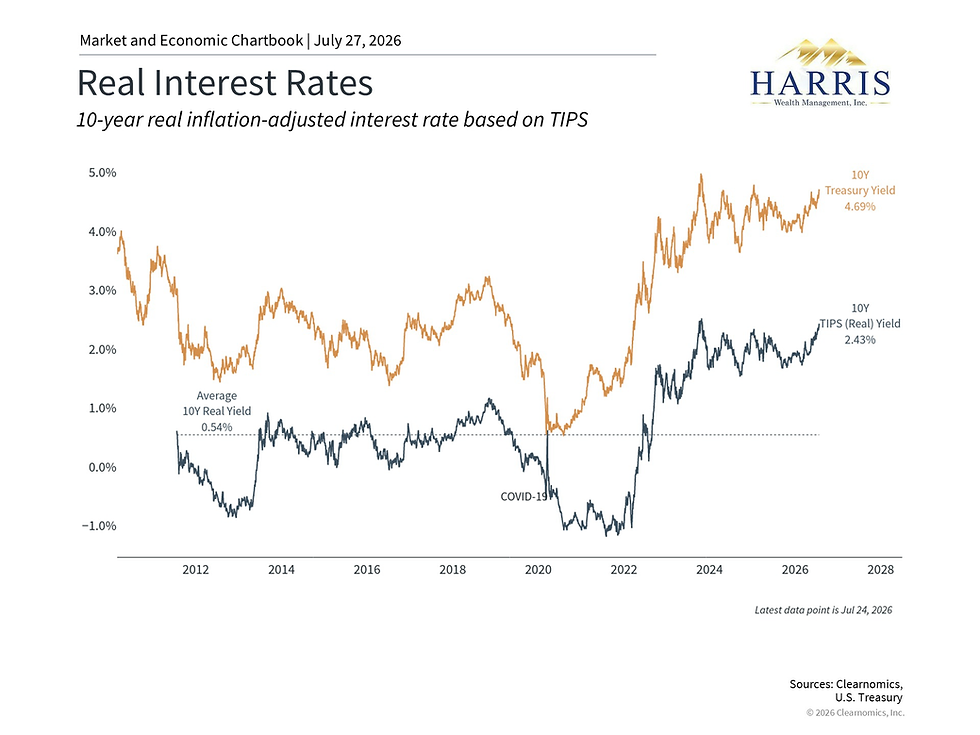
The chart above shows how real yields have changed over the past fifteen years or so. Back in 2020, real yields on government bonds actually turned negative. This meant that investors were either expecting very little inflation in the years ahead, or they were willing to accept a guaranteed loss of purchasing power just to hold the relative safety of U.S. Treasury securities. This was largely intentional, as the Fed cut interest rates to support the economy and encourage investors to put money into stocks, real estate, and other assets with higher potential returns.
Things shifted in 2022 when inflation spiked sharply, prompting the Fed to reverse course and raise interest rates at the fastest pace in decades. Both nominal and real yields climbed as a result. Today, the 10-year nominal Treasury yield stands at roughly 4.7%, while the corresponding real yield is 2.4%, well above levels seen since the global financial crisis of 2008. These figures reflect expectations for inflation over the next ten years, not just the most recent data.
Several factors are keeping long-term yields elevated. Oil prices have risen back above $90 per barrel for Brent crude amid the ongoing war in Iran, and gasoline prices have climbed back above $4 per gallon nationally.2 Higher energy costs can flow directly into broader inflation, which in turn pushes nominal yields higher. Notably, inflation expectations have not risen much based on market measures and surveys, largely because many expect the Fed may raise rates over the coming months to keep rising prices in check.
Separately, the growing national debt and federal budget deficit continue to create uncertainty around government bond yields. This affects what economists call the "term premium," which is the extra yield investors demand to hold longer-term bonds instead of shorter-term ones. With the total national debt now above $39 trillion, larger interest payments naturally raise the government's borrowing costs, pushing U.S. Treasury yields higher.3
Higher yields affect all parts of the market

Interest rates do not just affect bonds. They also influence how attractive different types of investments look when compared to one another. This is especially relevant for long-term investors, since it shapes the relative appeal of various asset classes within a balanced portfolio. The chart above illustrates the S&P 500 earnings yield, which is calculated by dividing a company's earnings per share by the price of the S&P 500. This is a useful measure for comparing the stock market to bond yields.
This comparison is often called the "equity risk premium," because it shows how much additional potential return is available from stocks compared to bonds, in exchange for taking on more risk. When real bond yields were near zero or negative, as they were for much of the period after 2008, stocks faced little competition. Investors accepted lower earnings yields from stocks because there were few other options for generating yield and growth. This environment was commonly referred to as TINA, or "there is no alternative."
At current levels, the 10-year real yield of 2.4% means investors can earn a meaningful, inflation-adjusted return simply by holding government bonds. The S&P 500 earnings yield sits at roughly 4.9%, which corresponds to a forward price-to-earnings ratio of around 20x. A price-to-earnings ratio is a way of measuring how expensive stocks are relative to their earnings. This means that carefully thinking through the balance of stocks and bonds in a portfolio may be more important now than it has been in recent years.4
The Fed balance sheet and what it means for yields

Another factor influencing bond yields is uncertainty around Fed policy under the new leadership of Kevin Warsh. One task force he has launched seeks to address the central bank's $6.7 trillion balance sheet, which refers to the total value of assets the Fed holds, mainly government bonds and mortgage-backed securities. As the chart above shows, the Fed's holdings have grown with each major economic crisis. While the balance sheet has shrunk somewhat in recent years as assets have matured, it remains far larger than it was before 2008.
Warsh has long believed that the Fed should reduce its balance sheet when the economy is healthy. Doing so would involve selling Treasury securities and mortgage-backed securities. When the Fed sells these assets, it effectively pushes bond yields higher, which raises borrowing costs for businesses and homebuyers alike. Combined with expectations of future Fed rate increases, these actions could keep both short-term and long-term interest rates higher for a longer period.
For long-term investors, this environment means it is more important than ever to hold a well-considered mix of stocks, bonds, and other assets that is designed to help meet financial goals.
The information provided here is for general informational purposes only and should not be considered an individualized recommendation or personalized investment advice. The investment strategies mentioned here may not be suitable for everyone. Examples are for illustrative purposes only. All investing involves risk of loss including the possible loss of all amounts invested.
References
4. Clearnomics research and LSEG data as of July 27, 2026


Comments